

newsroom19 | 10 | 2026
The question is no longer whether AI will transform marketing. It is who will build the solutions that define it.
Last week, Martin Carniglia, Director of Marketing Science at Bunker, represented the company at Google Changemakers in New York.
The event brought together leaders from agencies and technology partners of Google across the region, with a clear goal: to accelerate the growth of new business lines powered by artificial intelligence, advanced automation and Google's technology ecosystem.
Three days of debate. On his return, Martin came away with four core ideas. They structure this note.
The event
The agenda covered Next-Gen AI, Measurement, Creative Storytelling with AI and The New Economics of Advertising. Four distinct areas that, for Martin, point to the same question: the value model of marketing is changing, and the advantage goes to whoever has the tools and data to measure that change.
"Very intense days alongside leaders from agencies and technology partners of Google across the region, debating where our industry is heading." That is how Martin sums it up.
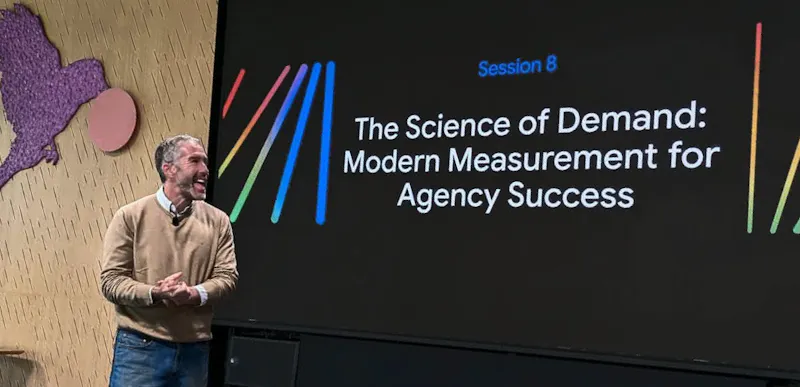
What he brought back from New York
Next-Gen AI
The AI conversation was less about which model to use and more about what happens when systems execute part of the buying, targeting and optimization. When the machine decides for you, the question stops being "do I have AI?" and becomes "do I have first-party data, measurement rules and judgment to review what it decides?"
This is where the agentic world Martin points to as the horizon comes in. Agents can already operate parts of the buying cycle. What they don't delegate is interpretation, and that is where the advantage lies.
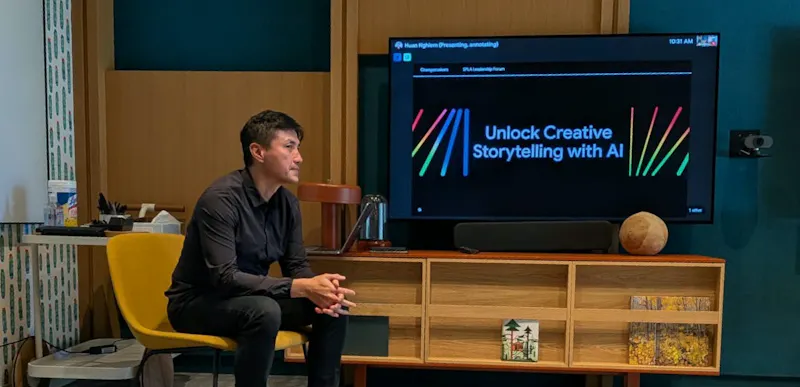
Creative Storytelling with AI
With generative AI, the cost of producing creative assets falls to nearly zero. That opens the temptation to scale volume without judgment. Martin puts the focus elsewhere: creativity is now the new way to segment. Whoever understands which story connects with which audience reaches results sooner.
Creativity remains one of the levers that most drives ROI.
Scale without judgment multiplies noise. Judgment without scale arrives too late. Balancing the two was one of the topics that came up most in the creativity panels, and Martin's conclusion is direct: mastering creative intelligence is what brings brands closer to their results.
The New Economics of Advertising
If the algorithm buys the traffic and AI produces the ad, value shifts toward two places: proprietary data signals and proof of real impact. Martin distills it into the idea he brought back most clearly: agencies and partners need to focus on models that quantify value before the effort invested.
What changes in practice
Charging by the hour or by the asset loses meaning once production is automated. The new standard is being able to say how much value each decision generates, before measuring the effort it took.
First-party data
When algorithms decide who sees what and at what cost, the only thing you can influence is what you feed them: which data goes in, with what quality and with what permission. That is why first-party data has stopped being a compliance topic and become a performance decision.
The question is no longer whether AI will transform the marketing business. It is who will build the solutions that define how.
Martin proposes two paths to put this into practice: strengthening the data signals you already have, and building and making visible the brand's value proposition, so algorithms, AI tools and agents have something valuable to read. That is the starting point of the vision he took to New York: combining proprietary technology with the MarTech ecosystem so data delivers business value, not just reporting value.
Measurement
With more automation, the risk is confusing correlation with impact. An attribution model tells you which touchpoint accompanied the conversion. An experiment or an MMM tells you how much of that conversion would not have happened without the investment. Martin insists the three tools are needed together: MMM, attribution models and experiments.
The catch
Automating the buy doesn't replace the incrementality question. If the algorithm optimizes on a biased signal, it scales the bias faster.
That's why at Bunker we combine MMM, attribution and experiments within a single framework. None is enough on its own, and together they give you an answer you can defend in front of your board.
Conclusion
Amid the transformation AI brings to marketing, organizing data, focusing on solutions that deliver value and orchestrating products and services that create real impact on the business matter more than ever.
— Martin Carniglia, Director of Marketing Science at Bunker
Martin returns from New York with a confirmation: at Bunker, we are on the right track. The forum's themes are closely aligned with the investment in technology and talent we have been making to support the region's leading companies in their analytics transformation.
Marketing Science is where that work becomes measurable: attribution and incrementality modeling with econometric precision, so you know what each investment delivers before you scale it. Measure what truly moves your business.
Martin Carniglia
Director of Marketing Science
1/9


