

newsroom17 | 11 | 2026
Search did not disappear. It expanded, changed shape, and stopped announcing itself.
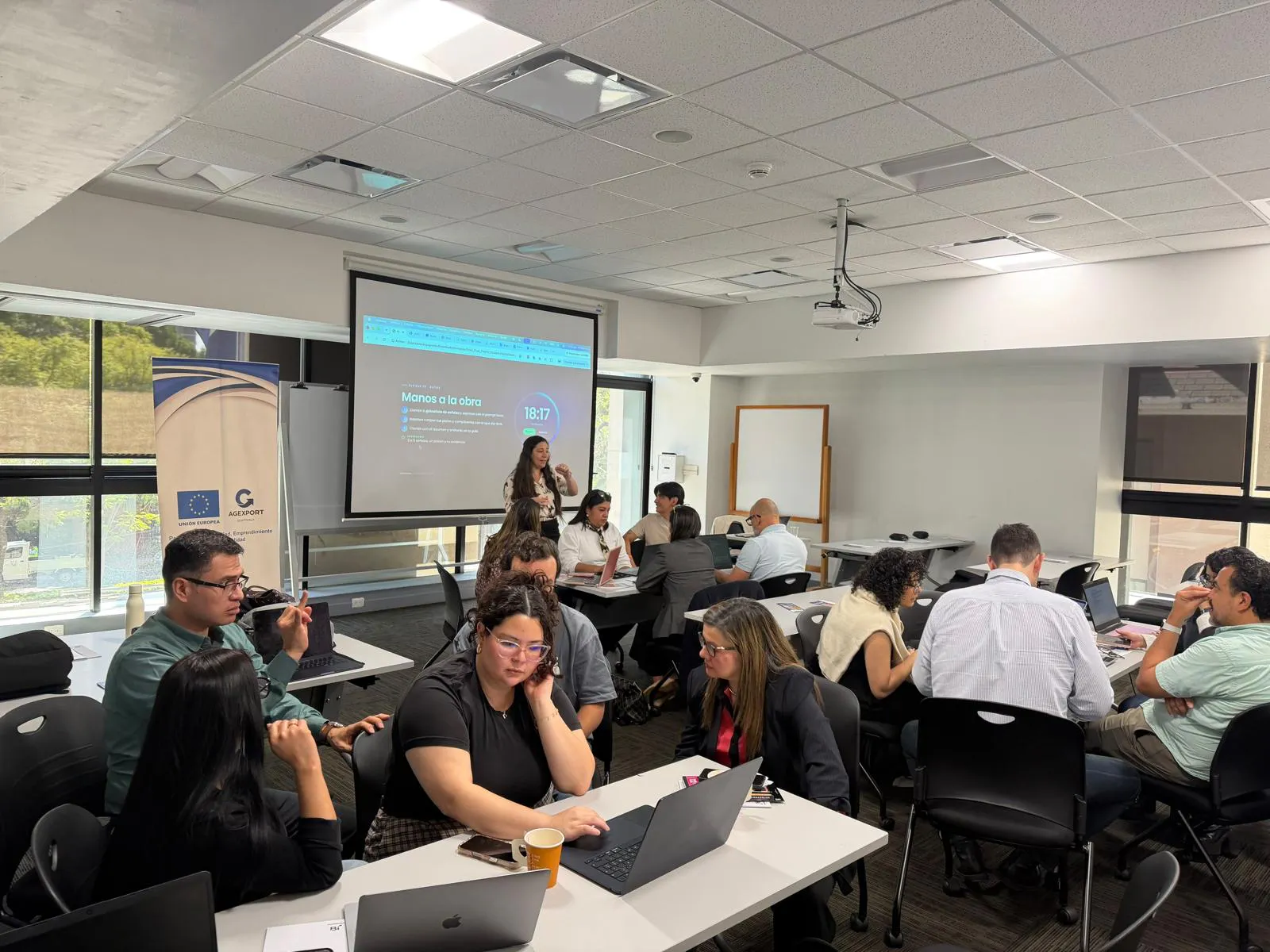
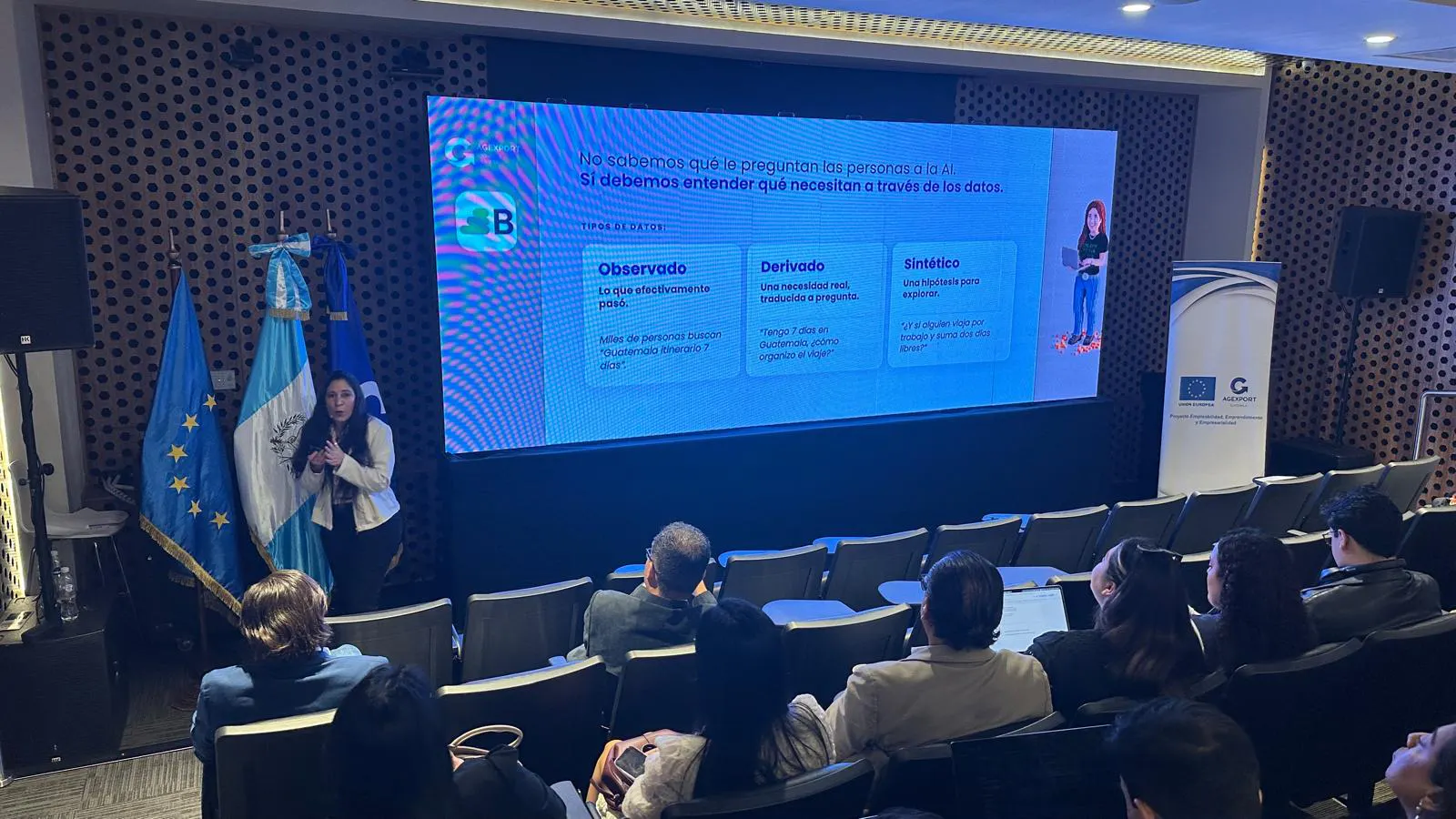
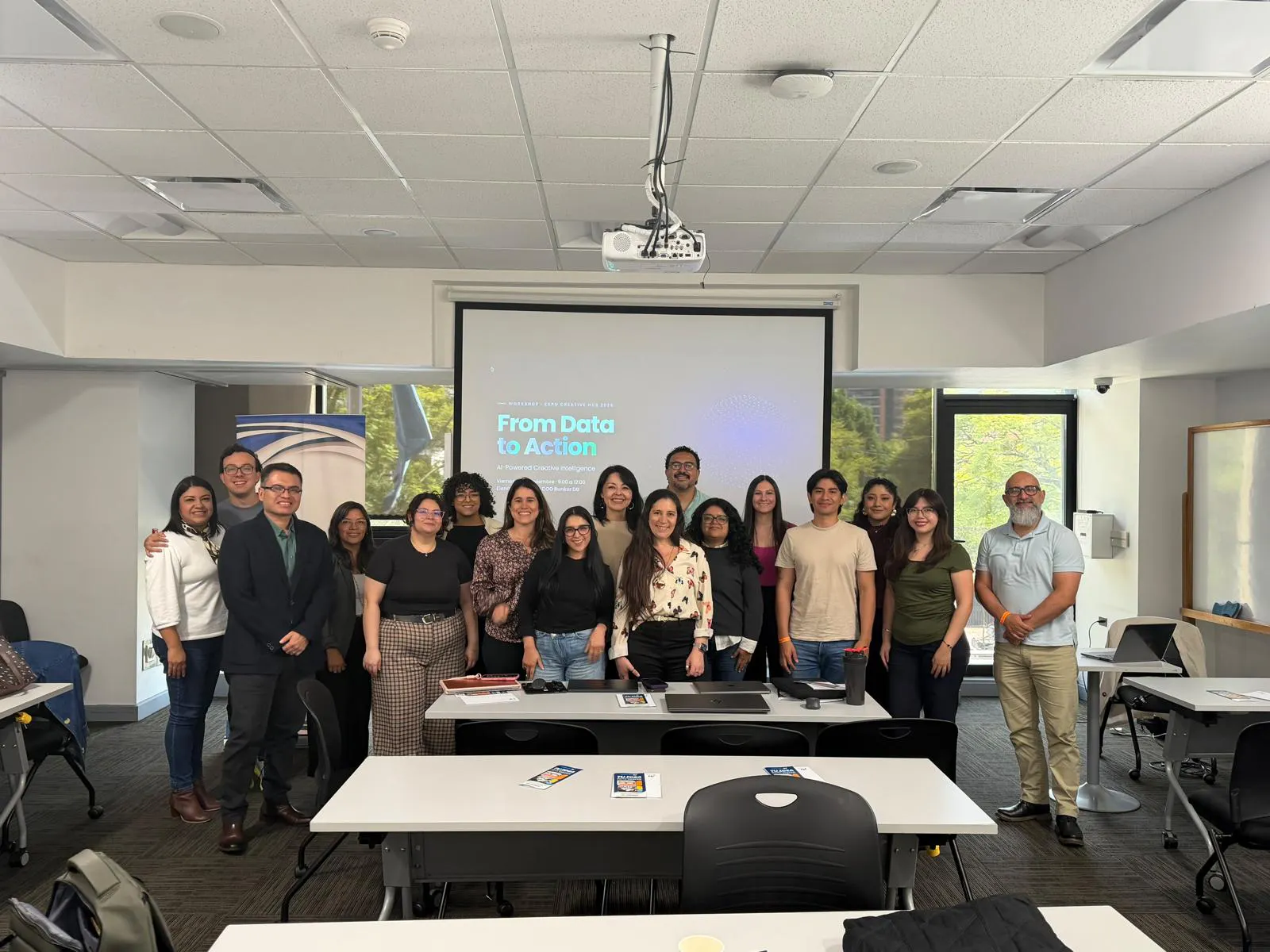
In early November, Bunker took part in Expo Creative Hub 2026, the 6th Orange Economy Forum that AGEXPORT runs in Guatemala. Elena Spagnuolo, our COO, took the stage with an uncomfortable thesis and an experiment to back it up.
The thesis: searching is no longer typing three words into a box and picking a blue link. Today a person tells an AI about their entire trip, compares without leaving the answer, and often decides without visiting a single website. For brands, that changes the underlying question.
For years, preparing for search meant optimizing a keyword. Now it means understanding the context of a decision and building the answer before anyone asks for it. This article walks through that shift, the method we use for it, and what an experiment on travel to Guatemala left us that applies to any category.
The shift
Think about the past decade. Booking a hotel became staying in someone’s home; waiting for the next episode, watching the whole season; hailing a taxi, ordering it from your phone. Every time a technology solved a latent need, a new habit was born that moved an entire industry. The same is happening with search: it stopped living only in the search engine and spread across social networks, communities, marketplaces, answer engines, and generative AI.
This is not a future hypothesis. Google’s conversational search (AI Mode) passed one billion monthly users a year after its launch, and AI-referred traffic is already growing at rates no channel has shown in years.
People per month · Google AI Mode
Using Google’s conversational search a year after its launch. Source: Alphabet, July 2026.
And it is not just any traffic. According to Adobe, year-over-year growth in AI-referred traffic is soaring by industry, and whoever arrives from an AI answer converts above average: that visitor already asked, compared, and filtered before clicking.
Adobe Digital Insights · U.S. · January 2026
Search is no longer a place you go to. It is a behavior that leaves signals everywhere.
The new question
While classic SEO answered "can they find me?", the conversation with AI opens new questions: do they understand me? am I part of the answer? do they describe me well? do they recommend me? does an agent pick me? It is the jump from SEO to AEO (optimizing for answer engines, the engines that respond), GEO (optimizing for generative AI), and, finally, AI visibility: how present and how well-described your brand is when AI builds the answer.
Here is the gap that stings the most. A brand can have plenty of public proof that AI never looks at; or it can be named by AI with little real evidence behind it. What AI believes about your brand and the proof that actually exists about it do not always match, and today that mismatch is a business problem, not a marketing one.
Preparing for this is no longer tweaking a title or repeating a keyword. It is understanding the full context of a decision in order to choose how to position yourself in front of whoever is searching, whether a person or a model.
The model
We call that work Search Intelligence, and it has two sides. The first is understanding: moving from signals to patterns, from patterns to insights, and from insights to decisions. The second is being chosen: becoming findable, understandable, relevant, and trustworthy, for people and for models.
The raw material is signals, and today they are everywhere. Every behavior leaves one, and each source says something different:
Big Data widens the universe of signals; AI widens our ability to interpret them. That is why intelligence is not one stage of the process: it runs through the whole thing, in a cycle of listen, understand, model, and decide, and then act, measure, and learn.
The experiment · Listen
To show it with our own data, we built an experiment with a fictional travel brand, Latitud Travel, around a real question: how does someone planning a trip to Guatemala decide? The terrain is ideal, because AI-referred traffic to travel sites grew 323% year over year.
For six days we listened to the public conversation on the web, Facebook, YouTube, Instagram, X, and Reddit. Out of all that noise, we kept what really mattered:
Proprietary corpus · October 19 to 24, 2026
A generic search like "what to do in Guatemala" hides very concrete intentions: five, seven, or ten days? what do I leave out? how much does it cost? how do I connect it all? The job is not to read the search, it is to understand the intent. When we organized the conversations by what people were trying to solve, four out of ten were about nature and adventure, logistics, or culture, and one in four, about value and budget.
From there we modeled three synthetic users, profiles built from the conversations to test decisions:
The common ground among all three is logistical honesty. And the positioning that emerges is clear: not the brand that shows every destination, but the one that helps you choose.
The experiment · Act
With that diagnosis, the temptation is to create more content. But that is not the opportunity: it is to help resolve decisions better. In the experiment, that translated into four concrete outputs.
The underlying point is that we no longer speak only to people. We also speak to an AI, and it is worth taking seriously: according to Clutch and Conductor, 77% of content teams already write with LLMs in mind.
The nuance
Opening up to AI does not mean giving away the content or automating the strategy. Critical judgment, brand criteria, and professional oversight stay on the human side. AI speeds up analysis and production; the decision, no.
The experiment · Measure
Showing up in an answer is not enough. What matters is which answers you show up in, for which need, and with which sources behind them. That is why we work with four metrics that turn "AI talks about us" into something actionable.
| Metric | The question it answers |
|---|---|
| Share of Model | In how many AI answers do you appear? |
| Share of Recommendation | In how many does it actually recommend you, not just mention you? |
| Intent Share | Which type of need do you dominate? |
| Source Share | Which sources does AI pull from for your category? |
A warning we learned firsthand: if you ask an AI for its own Share of Model, it replies with convincing data and charts… all made up. So you do not ask it: you measure it, with a method that starts from real demand, translates it into questions, runs them across several AIs several times, and only then extracts brands, attributes, and sources.
When we did it for travel to Guatemala, the result was telling. On the broad question (planning the trip), global platforms like GetYourGuide and Viator won. On the specific one (how to get between destinations), local operators won. Dominating one need is not the same as dominating the category, and there is room there for brands that do not yet show up in the broad queries.
The takeaway
Today’s answer is tomorrow’s signal. Measuring the same benchmark month after month turns AI into a thermometer for whether what you did moved the needle.
The context
The stage where Elena presented this is no coincidence. Expo Creative Hub 2026, AGEXPORT’s 6th Orange Economy Forum, was held on November 5 and 6 in Guatemala City, and it brought together agencies, studios, production companies, and brands around one goal: exporting higher-value creative services.
The gap driving that goal shows up in the numbers. The global creative-services market reached US$1.7 trillion in 2024, with 12% year-over-year growth, according to UNCTAD. Guatemala, by contrast, exported US$19.14 million in its orange economy in 2025: five straight years of growth, but at a 2.6% pace. Although the figures are not directly comparable (the global one includes software and R&D), the difference in speed explains why AGEXPORT put AI, data, and measurement at the center of the forum, with its sights set on US$35 billion in total exports by 2035.
The forum also made clear that the topic goes beyond Bunker. Emanuel Rébori, from Grupo Comercial de Comunicaciones, worked on the link between digital strategies and commercial results across more than 200 brands; Tiago Willveit, from Aputure, brought professional lighting technology to the audiovisual field; and an agentic-design workshop showed how to integrate AI agents into research and ideation without losing human oversight. In parallel, AGEXPORT’s alliance with IAB Guatemala aims to adopt technology responsibly: the same tension between power and judgment that runs through Search Intelligence.
Read from Bunker, the underlying shift is this: the region has been competing on cost, as an execution provider, and the next leap is to compete on value, with intellectual property, data, and measurement. On that board, MarTech stops being a luxury and becomes the passport: what lets you prove to an international client the real impact of what you do.
Getting started
At Bunker we work on Search Intelligence end to end: we listen to the conversation with Social Listening, interpret those signals with Big Data and AI, and turn them into decisions and content that people and models can find, understand, and choose, always with human judgment in the loop. Having data is the starting point; the advantage is in shortening the distance between a signal and a decision, and between a decision and action.
Lucas Suarez
Marketing Analyst
1/9


